
Better Custody Schedules than Every Other Weekend

Every other weekend is perhaps the most well known and common child custody schedule. But other parenting timetables can be better for children, allowing them to see both their parents often.
Among the best alternatives to this particular routine are 70/30 and 60/40 custody schedules. But the optimal schedule is always case-dependent. Every other weekend tends to be best mainly for older children whose parents live quite far apart.
Problems with the Every Other Weekend Custody Schedule

An every other weekend schedule means that you have a custodial parent and a non-custodial (or occasional) parent. A child lives with one parent and visits the other parent on alternating weekends. Usually, parenting responsibilities are more even for school holidays, which may be shared 50/50.
The biggest problem with the simple every other weekend schedule is the gap between regular visits with the secondary carer, who is usually the father. Even if that parent collects the child from school on Friday afternoon for a visit and drops them back there on Monday morning, there is a gap of more than 11 days until the next “other weekend” begins. This long absence happens even fortnight.
Routinely going for 11+ days without seeing a parent obviously harms the parent-child relationship. The parent is rarely there for unexpected life events. And they cannot effectively guide the child on a daily basis. Although digital and other forms of communication can help bridge the separation gap, the non-custodial parent is typically not present and can only have a limited influence on a child’s upbringing.
Terminology
70/30 Custody Schedule Examples
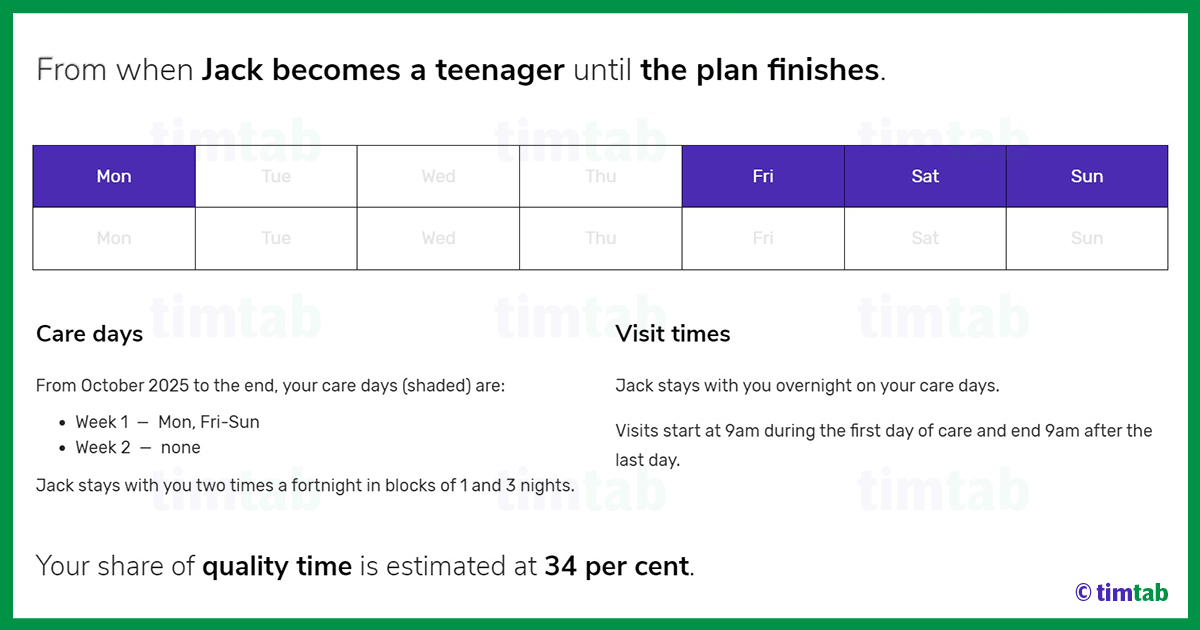
A slightly more balanced arrangement than every is a 70/30 child custody schedule. The 70% to 30% time split works out to a child spending 4 out of every 14 nights with the occasional parent. This is above the maximum 3 nights per fortnight under an every other weekend timetable.
A. 2 out of 3 weekends
Especially where distance is an issue, parents might consider agreeing on a two out of three weekends custody agreement. The child lives with one parent but only spends one weekend out of three with him or her (usually the mother). The child visits the other parent only on weekends but does so for two out of every three.
B. Every other weekend plus a Monday
A slight variation on the every other weekend schedule is to add a Monday visit with the secondary carer on the Monday after the weekend that they don’t have the child or children. The extra Monday visit breaks up the long block of time the child or children would otherwise not see one parent.
C. Two-night weekend plus Thursday and Monday
For younger children, another good 70/30 option is to have a 2-night visit with the occasional parent on alternating weekends. This could be Friday and Saturday together or Saturday and Sunday nights. Along with the 2-night weekend visit, you add Thursday and Monday visits to the schedule.
65/35 and 60/40 Custody Schedules
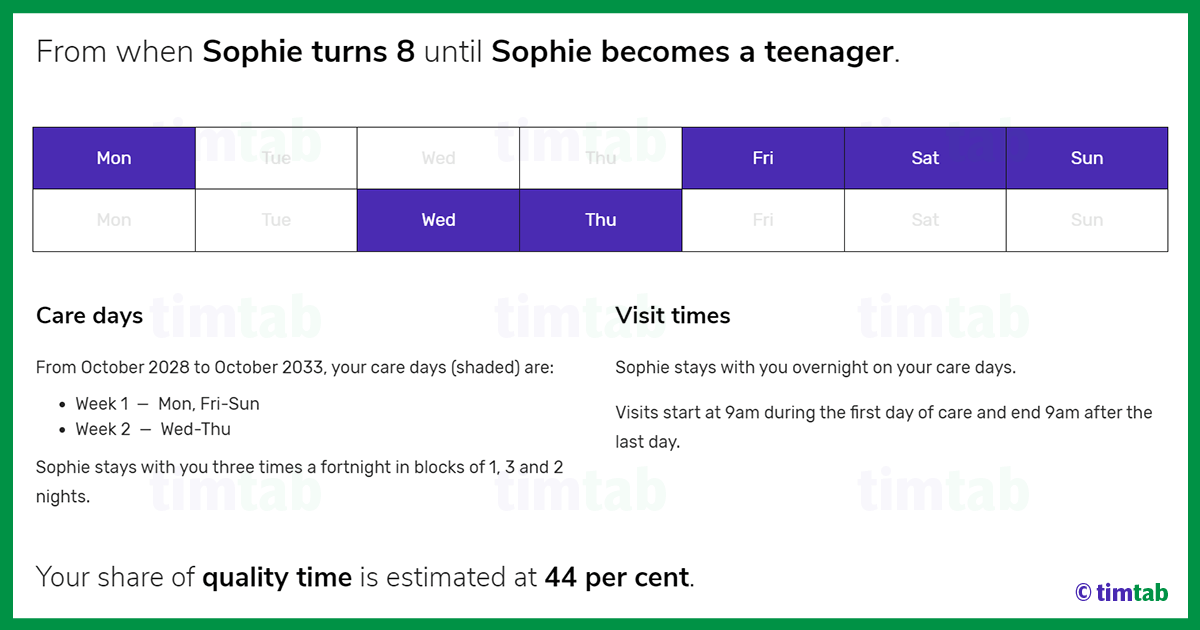
To provide more balance, extra overnights with the noncustodial parent can be added to the schedule. Five nights per fortnight corresponds with a 65/35 schedule and six nights represents a 60/40 ratio. And, of course, seven nights is 50/50. All these schedules may be considered joint physical custody, shared parenting and co-parenting, meaning you don’t have a “non-custodial” parent as such but two co-parents instead.
A. Every other weekend plus Thursday and Monday
A slight variation on Schedule C above is to make the weekend a 3-night extended weekend from Friday to Monday morning. This produces a 65/35 custody schedule: every other weekend plus Thursday and Monday,
B. Every other weekend plus Wednesday, Thursday and Monday
One of the popular 60/40 schedules consists of a 3-night weekend with the minor-care parent followed by visits on Wednesday and Thursday nights and then the following Monday. This 60/40 custody schedule is highly balanced and relies on co-parents living quite close to school.
We Can Do Better Than a Fortnightly Weekend Visit

The schedules shown here are just a sample of the range of custody arrangements that are superior to every other weekend. Each of them offers better balance and, in particular, gets the parent with the least amount of care more involved their child’s life.
Shared parenting has been demonstrated to provide many benefits for children. And family law legislation often emphasizes the importance of the primary carer fostering a meaningful relationship between their child and the other parent.
Perhaps the only significant barrier to using these alternative schedules is parents living far apart. So, the message to separated parents is to try to live reasonably close to one another. That way, your child can enjoy the advantages of seeing their co-parents often.
When You Can Move Away from Every Other Weekend

Given the relationship costs, really an every other weekend schedule is best only if the parents live a considerable distance from one another. Distance makes regular travel between homes impractical. In particular, getting a child to and from school each day takes too long from the distant parent’s home.
A different custody agreement should be considered if the longest travel time between a home and school is less than, say, one hour. While there are no hard and fast rules, a maximum travel time under an hour leaves scope for at least one extra overnight visit to be included on the fortnightly calendar.
it’s not my it’s our son get it right.
My son is 20 months. He is currently doing a every other weekend plus an alternating Wednesday to Thursday schedule with his father. It is obvious to myself and also his babysitter that the few days after spending time with his father he struggles to get back to a routine and his behaviours heighten. It takes him 2 or 3 days to get back to routine and then he is back to his happy self, but then he quickly has to go back to his dads. His dad lives over an hour away and has a busy work schedule but is wanting more time. We are struggling to find common grounds as I feel our son needs routine and adding more change to his schedule will confuse him even more. He has never been away from me more than 3 nights and struggles with separation. Any suggestions?
Kids are highly adaptible but, like anyone, can be disrupted by a change of surroundings and routines. This can work provided your son is given every opportunity to form a predictable routine that he understands. Some tips are to be matter of fact about changeovers. Let him know it’s coming up but don’t make a big deal about it. Try to leave the house in the same state when he arrives as when he left (e.g. toys haven’t moved). 20 months is a difficult age. They don’t quite understand what is happening and an overnight away seems like a long time. But that will all change soon as he matures. It is vital that he maintains close contact with both parents, which will allow him to be comfortable with being away from you. For the time being, the time away should be brief (a night or two at once) but as often as can be managed.
Hi Dora, have you figured anything out? My daughter is a year old and I’m in the same boat as you with the visitation.
Please help.
Right now. My sons dad thought it was a good idea to do alternating weekends when he lives 3 hours away. My sons behavior has suffered, and I think it’s in part because of the back and forth travel so often during the school year. Holidays split in half/alternating seem to be working just fine. It’s just the alternating weekends. What would you suggest?
I regret just agreeing to it in mediation instead of fighting for something more manageable.
How does your son feel about it? The visits away may slow down as your son gets older and everyone gets sick of all the travel. You could encourage communication by phone. One option would be to offer up some holiday time for extra weekends. Every 3rd weekend would be more sensible.
honestly, 3 hours is hard, but your son needs his dad. maybe instead of every other move to every weekend so he always has that time. clearly this depends on his dad and how much he cares that he is there.
What about the Fathers who want their Child Every weekend, and are told by Your Lawyer it’s the Law to only have 3 weekends a month with your Child, which is Basically 6 days a month, the Law feels that is enough
I and my ex-wife are on fine terms and we are struggling with the schedule to follow with the custody of our kid. This article is a huge help and I think we can use it to come to an appropriate solution for both of us. The idea of 70 /30 looks very good.
My ex-wife and I have a pretty stable relationship, all things considered, and we had considered other options outside of this one. We both need weekend time to ourselves to catch up on things but we both also work Monday-Friday. We decided to do a full week on and off because of this. We live really close by to each other and it worked for our schedules. This way neither one of us feels we are missing out and we both have weekend time to ourselves.
How old are your children?
What are the options for if the “non-custodial” parent lives an hour away from school and the Custodial parents’ home?
Hi Rachael. It depends on the age of the child . For a young child, you might still include visits during the week. As the child gets older, this becomes more of a hassle than it’s worth. Then, you might do 2 out of 3 weekends with the non-custodial parent. Try timtab.com. The software will suggest a schedule for you, automatically accounting for age and travel time factors.
Thanks for letting people know that flexibility can be a good thing. The most important component of any custody schedule is your child’s (or children’s) best interests. If you need to try something different, why not do what’s best for your child’s long-term health? I just don’t understand why some parents are so inflexible with accommodating their kids’ best interests.
Parents need to be flexible but everyone knows that doesn’t always happen. Every other weekend provides some structure, but it is terrible for a parent awaiting visitation. I like the different plans you present here, especially the extra Monday and 2 out of 3 weekend plan. Thanks for sharing this because I know parents/guardians and people in the court system are always looking for solutions.
It goes for both parents not just the visitation parent. Every other weekend means mom and father miss time equally
These are great suggestions. Every other weekend shouldn’t be seen as OK. We should try to do better. Ideally, the parents make an effort to live close enough to each other that 50/50 or something approaching that is logistically possible.